Invertebrate Animals Brochure

brochures

This fourth-grade brochure on invertebrates is ready for printing. It contains essential information about invertebrates in an engaging and easy-to-read format, helping students learn how to identify them, their key characteristics, features, and importance to the environment. An activity has also been added to assess students' comprehension of the information.
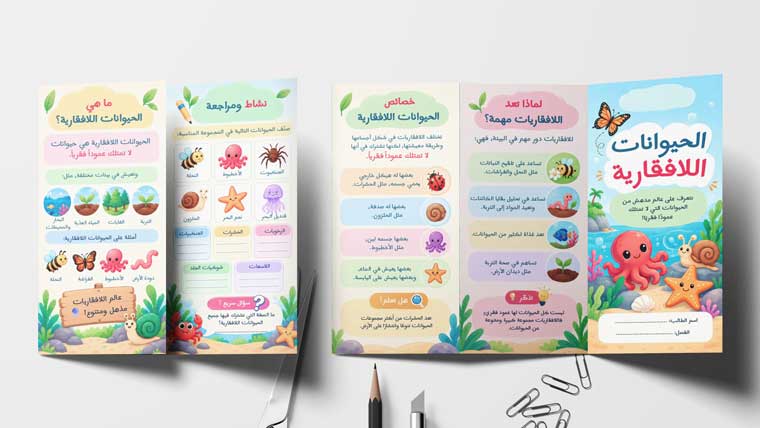
  • The invertebrates brochure for fourth grade is ready and contains:
    • Definition of invertebrate animals: These are animals that do not have a backbone.
    • The most important groups of invertebrate animals: Arachnids such as scorpions and spiders – insects such as ants and bees – mollusks such as octopuses – worms such as earthworms – cnidarians – echinoderms such as starfish
    • Activity and review Review questions for information the student learned in the brochure: Classify the following animals – What is the common characteristic of invertebrate animals?
    • Characteristics of invertebrate animals: Some have a skeleton – some have a shell – some have a soft body – some live in water – some live on land
    • The importance of invertebrate animals: Invertebrates play a role in protecting the environment by pollinating flowers, decomposing remains, providing food for other animals, and contributing to soil health.
  • The template is compatible with all Office PPT versions.
  • Identifying the different groups of invertebrate animals
  • Understanding the importance of invertebrates
  • Linking science with the surrounding environment
  • Various examples of invertebrate animals
  • The brochure can be easily edited in PowerPoint.
  • All texts are editable according to the teacher's needs.
  • Combining information, images, and activities in one brochure
  • Children's-friendly cartoon drawings and images with bright colors suitable for elementary school students
  • Helping students to retain and remember key information about invertebrate animals
  • The handout is a suitable tool for the teacher as it is appropriate for use in reviewing material after the lesson.
  • Easy to prepare the brochure for distribution
  • The brochure is easy to carry and store due to its small size.
  • Encouraging students to love science and learning
  • Teaching students to observe and compare animals
  • The lesson is linked to the student's daily life through examples of animals and insects that the student sees every day.
  • The brochure helps make lessons more engaging for students.
  • Encouraging students to participate and discuss, and motivating them to ask questions.
  • It can be customized so that the student can write his name and class on the brochure cover.
  • Suitable for distribution in the classroom
  • The cost of printing the brochure is low as it can be printed on regular printers available at the school.
  • To edit this template you will need PowerPoint. If you have Microsoft Office installed on your computer, you can find PowerPoint in the Start menu. If you don't find it, you must first purchase and install it by visiting the Microsoft website. .
  • When you open the file for the first time, you must click on “Enable Editing” when this message appears at the top of the screen in order to be able to view and edit the file .
  • Instructions for use are included with the last slide.

This template was designed by Inggez and no one has the right to republish or distribute template files or modified versions on other sites without written permission from Inggez
Similar Posts